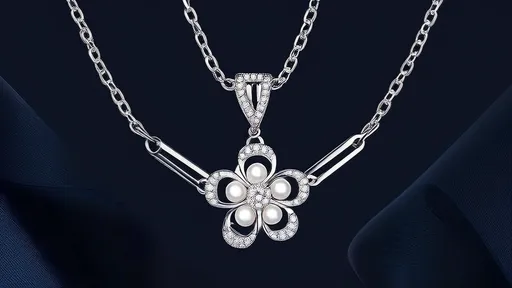
The world of fine jewelry has always been a fascinating intersection of artistry and engineering. Among the most intriguing developments in recent years is the emergence of quick-release pendant systems for evening necklaces—a seemingly small innovation that has quietly revolutionized how women wear and interact with their jewelry. These mechanisms, often hidden from view, represent a triumph of micro-engineering that maintains aesthetic integrity while solving practical problems.
Traditional pendant necklaces, especially those designed for formal occasions, have long suffered from a fundamental limitation: their static nature. Once a pendant is attached to a chain, it typically remains fixed in place until professionally removed. This limitation became particularly apparent with heirloom pieces or investment-grade jewelry where owners might wish to alternate between different pendants without maintaining multiple chains. The quick-release systems now appearing in high-end collections address this exact pain point with remarkable elegance.
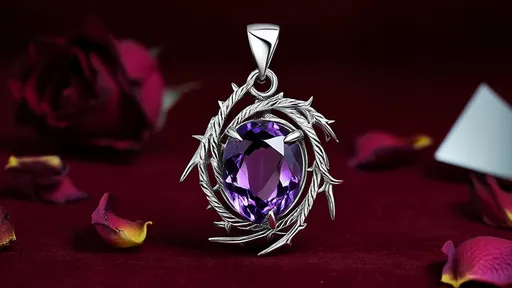
The mechanics behind these systems often involve precision spring-loaded mechanisms or magnetic closures engineered to withstand surprising amounts of weight. What makes these innovations particularly impressive is their ability to maintain security while remaining nearly invisible when the piece is worn. Luxury houses have developed proprietary systems—some using aircraft-grade aluminum components, others employing specially tempered steel—all designed to bear the weight of substantial gemstones without compromising the necklace's delicate appearance.
Material science plays a crucial role in these designs. The challenge isn't merely creating a mechanism that can support weight, but doing so using materials that won't degrade over time or react with precious metals. Rhodium-plated components have become particularly popular for their durability and resistance to tarnishing. Some manufacturers are experimenting with ceramic components for their remarkable strength-to-weight ratio and hypoallergenic properties.
From a design perspective, these systems have opened new creative possibilities. Jewelers are no longer constrained by the need to permanently incorporate pendants into their designs. This flexibility has led to innovative collections where a single chain can serve as the foundation for multiple statement pieces—a boon for both designers and consumers. The modular approach aligns perfectly with contemporary preferences for versatile, customizable luxury items.
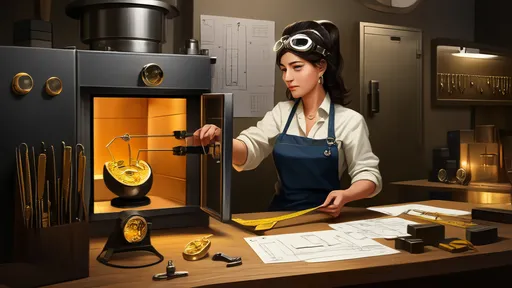
The development process for these mechanisms often involves extensive testing far beyond what one might expect. High-end manufacturers subject their quick-release systems to rigorous trials—simulating everything from accidental tugs to the weight of vigorous dancing. This attention to durability reflects the understanding that evening jewelry must withstand real-world conditions while maintaining its flawless appearance.
Market response to these innovations has been overwhelmingly positive. Sales data suggests that necklaces featuring quick-release systems consistently outperform their traditional counterparts, particularly in the $5,000-$20,000 price range. Consumers appear willing to pay a premium for the convenience and flexibility these systems offer, recognizing both their practical utility and the engineering achievement they represent.
Looking ahead, industry observers anticipate further refinements to these systems. Emerging technologies like nano-scale 3D printing may soon allow for even more sophisticated mechanisms at smaller scales. Some designers are experimenting with smart features—imagine a pendant that automatically secures itself more firmly when it detects sudden movement. As these systems evolve, they're likely to become standard features rather than innovations in high-end jewelry design.
The quiet revolution of quick-release pendant systems exemplifies how thoughtful engineering can enhance even the most traditional luxury items. By solving a practical problem without compromising aesthetics, jewelry designers have created pieces that are as smart as they are beautiful—a perfect marriage of form and function for the modern age.
By /Aug 19, 2025
By /Aug 19, 2025
By /Aug 19, 2025

By /Aug 19, 2025

By /Aug 19, 2025

By /Aug 19, 2025
By /Aug 19, 2025
By /Aug 19, 2025
By /Aug 19, 2025
By /Aug 19, 2025
By /Aug 19, 2025
By /Aug 19, 2025

By /Aug 19, 2025
By /Aug 19, 2025
By /Aug 19, 2025
By /Aug 19, 2025
By /Aug 19, 2025
By /Aug 19, 2025

By /Aug 19, 2025

By /Aug 19, 2025
